Dick-and-Jane primer
The Bluest EyeThe Dick-and-Jane primer is a reading lesson whose idealized household—Mother, Father, Dick, and Jane in a pretty green-and-white house with a red door—stands in stark contrast to the poverty, racial hierarchy, and fractured lives the novel depicts. Its sentences recur in different forms, moving from a legible children’s story to compressed, unspaced capital letters and, finally, a structural emblem of the book’s inability to give shape to Pecola’s silence.
The Lesson and Its Ideal Family
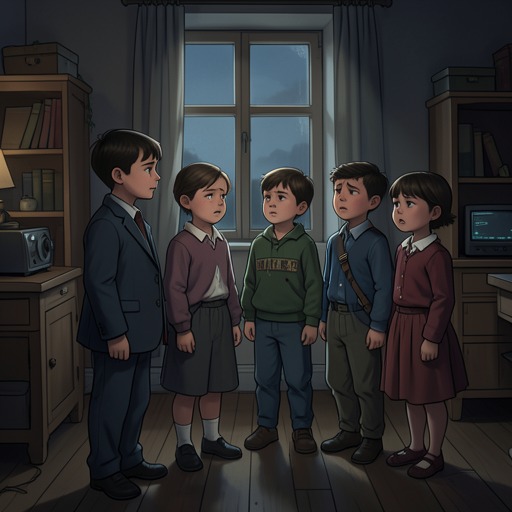
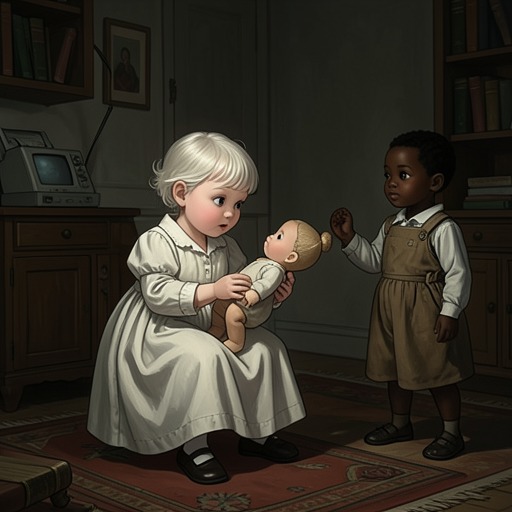
The primer begins with a neat sequence of declarative sentences: the house is green and white, it has a red door, and it is very pretty. The family living there consists of Mother, Father, Dick, and Jane, who are said to be very happy. Jane wears a red dress and wants to play; the lesson introduces a friend who will play with her, ending in an encouraging repetition of Jane’s name and the command to play. The simple syntax and reassuring domestic scene make happiness seem as orderly and readily available as the reading exercise itself.
The refrain appears not just once but in multiple forms. One version retains punctuation and line breaks, another removes much of that punctuation, and a later rendering fuses the words together in capitals. In the most compressed appearances, the house’s prettiness and the family’s happiness become a nearly unbroken stream of text. The shift changes the lesson from an apparently transparent model of reading into a visible pattern whose insistence and rigidity can no longer be overlooked.
The Primer Against the Novel’s World
The primer’s bright, secure home offers a pointed contrast to the Breedloves’ circumstances. The novel explicitly sets the family’s life against the primer’s happy household, making the lesson’s ideal of domestic order a measure that exposes rather than explains the gap between its promise and the lives around it. The contrast is not simply between one house and another: the primer presents a family whose happiness appears natural and complete, while the surrounding narrative reveals how poverty and racial exclusion constrain the conditions in which Black families live.
The contrast also extends beyond the household. Another repeated lesson presents a large, strong father smiling and asks whether Father will play with Jane. Against the novel’s accounts of unequal safety and family relations, this reassuring image gives paternal strength the uncomplicated meaning of protection and play. The primer’s model does not accommodate the circumstances of characters whose lives are shaped by racialized vulnerability, or the different burdens borne by Black women and girls. The text’s juxtaposition of its children’s lesson with their world makes the gap between the ideal and lived experience part of the book’s form.
Repetition, Disruption, and Silence
The recurring primer passages act as a formal counterpoint: their stable family and rhythmic instructions return while the larger narrative moves through painful, incompatible circumstances. In the novel’s closing reflection on its design, the seasonal structure is described as holding together a shattered world in childtime while repeatedly commenting on the white-family primer. Yet the reflection also identifies a limit: this structure does not effectively shape the silence at the novel’s center, the void called Pecola’s “unbeing.” The primer’s ordered language can be set against that absence, but repetition alone cannot give the absence a complete form.
That tension makes the primer more than a sample of beginner reading. The seemingly effortless claim that the family is happy acquires force through its return beside hardship, exclusion, and the novel’s central silence. Its increasingly disrupted appearance exposes the strain of fitting lived experience into a prefabricated picture of home, while the unresolved gap at the center prevents the contrast from becoming a simple, finished explanation.